Wealth Gap through the power lens
By: Ava Knoll
Power can be defined as “the actual use of resources to influence and control others,” as well as “when the power majority controls resources, it also controls the life chances of the minority” (Dworkin & Dworkin, 1999). In an interview with Lisa Citron, an economics teacher at Cascadia, she talked about how the poor have little power, and this has much to do with the fact that wealthy people have many more resources at their disposal for preserving their power and wealth. On the other hand, the less fortunate lack many of the resources that are available to the wealthier population, which leads to the creation of a significant wealth gap.
One clear example of a wealth gap that has existed since the colonization of America is that of the gap between black people and white people. Racism is a critical factor affecting the wealth gap because of “how [it] is impacting education, employment, income, credit, housing, and inheritance” (Al-Bahrani et al., 2019). Since the early 1600s, discrimination towards people of color has been very prevalent. Black people were viewed as “childlike and mentally deficient” (Takaki p.101), making it extremely difficult for them to be hired. In turn, they were not able to support their families and as a result, their accumulation of wealth was drastically hampered, compared to that of the majority of whites. “In the eighteenth and nineteenth centuries, print put forward a definition of intelligence that gave priority to the objective, rational use of the mind and at the same time encouraged forms of public discourse with serious, logically ordered content” (Postman p.51) making reading an essential skill to have. However, Ronald Takaki writes that many slaves did not know how to read and when given the chance, it was often taken away from them because it was believed that “learning will spoil the best nigger in the world” (Takaki p.114). This placed the African American population at an extreme disadvantage in their ability to gain and pass on wealth to future generations.
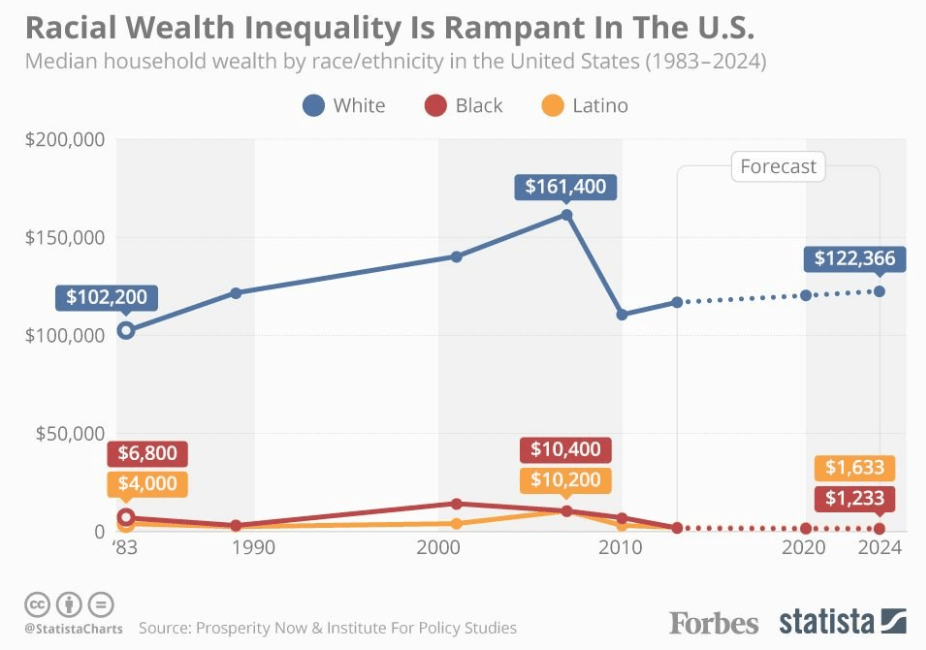
The mistaken belief that black people are lesser than whites leads to blacks being “less likely to be hired, receive lower wages when hired and are less likely to be promoted” (Al-Bahrani et al., 2019). The root cause of this stems from the fact that minorities are less likely to achieve higher levels of education, often because the families on the lesser side of the wealth gap cannot afford to have their kids go to college. This lack of funding sets up a common issue found between the two sides of the wealth gap. Consider an example case of two students trying to get into the same university. Student A, from a poor African American family, received a 4.0 in high school, is a varsity sports player, scored high on their SAT/ACT, and overall has a very strong application. Student B comes from an extremely wealthy family, was not the best student, and overall did not try hard in school. Student B, coming from a very high-class family, can manipulate the system and make it seem as though they are a fantastic student so that they can get into the school, often with large monetary donations being involved. In this particular situation, student B could be picked to attend the school over student A. In 2019, major news was broken regarding USC admission scandals which involved this exact type of scenario. Many parents were paying the school and lying on their children’s applications in order to get them into the University of Southern California. A famous actress, Lori Loughlin, along with her husband, bribed the school to get their eldest daughter into USC. As a result of these schemes, many kids who came from lower-income families, and had more deserving applications, were being set aside in preference for the kids whose families were simply paying for their kids to be accepted into the school. This is an example of how wealth can be used to breed more wealth, even when little to no actual merit or effort is involved.

The “socioeconomic and political structures of this county (i.e. racial barriers deeply ingrained in our culture and infrastructures) are what cause the uneven distribution of wealth” (Al-Bahrani et al., 2019). The way that America works today is that wealthy people stay wealthy. Many governmental policies help protect these people’s wealth, such as tax cuts geared towards wealthy people. Lisa Citron says that nothing is keeping high incomes from increasing. The wealthier you are, the more easily you can protect your wealth. Conversely, the poorer you are, the harder it is to even maintain what you have, which places you in a poverty trap. A poverty trap is based on the idea that “poverty can be conceptualized as a self-reinforcing phenomenon limiting the growth of an individual’s wealth” (Mirza et al., 2019). This is most often correlated with access to resources. Those who are wealthy and powerful have many more resources that help them keep their wealth, while those who are less wealthy do not, and may not ever, have access to those same resources. For example, in a city such as Seattle, there is so much wealth because of the booming technology industries of Amazon, Boeing, and Microsoft. Looking at these companies, those that work for, or are associated with, these companies make up some of the richest portions of the population. Not only do they hold much of the city’s wealth, but they also hold much of the power. This large amount of centralized money causes a significant impact on the poor. The rapid injection of large amounts of money coming into Seattle causes housing prices and overall costs of living to increase. The increasing cost of living and lack of affordable housing means that many people cannot afford to live in Seattle and sometimes end up on the streets. Seattle is just one example, but this is a problem plaguing many large cities across the nation. When looking at major cities with rapid income growth, you will always see the rich, high-class people occupying the majority of the landscape, and many people suffering from poverty who are living on the streets or in their cars.

Power plays a vital role in defining wealth gaps. This can be seen, not only by looking at the racial wealth gap where whites hold more power and are therefore wealthier but also when viewing cities as a whole. Exceptionally well off cities are an unfortunate showcase of how many people remain in poverty because they are unable to access the resources required to live there. They often lack the skill or intelligence needed to improve their situation, and this problem persists to the generations which follow them. The poor have little power, and it is hard for them to gain wealth when there are few policies in place to help them, they have limited opportunities, and they are unable to access things such as a good education. They are predisposed to lower salaries and limited power, thus continuing a gap where those that are wealthy stay wealthy and those that are poor are stuck in a poverty trap that is extremely difficult to escape.
References
Al-Bahrani, A., Weathers, J., & Patel, D. (2019). Racial Differences in the Returns to Financial Literacy Education. Journal of Consumer Affairs, 53(2), 572-599. Retrieved from EBSCOhost database. (Accession No. 1808848)
Citron, L. (2020, February 12). [Videoconference interview by A. Knoll, A. Faamoe, & I. Mankis].
Mirza, U. M., Richter, A., Van Nes, E. H., & Scheffer, M. (2019). Technology Driven Inequality Leads to Poverty and Resource Depletion. Ecological Economics, 160, 215-226. Retrieved from EBSCOhost database. (Accession No. 1764979)
Postman, N. (2006). Amusing ourselves to death: Public discourse in the age of show business. New York, N.Y.: Penguin Books.
Takaki, R. T. (2008). A different mirror: A history of multicultural America (Revised ed.). New York: Back Bay Books.
Taylor, K. (2020, January 15). How U.S.C. Courted Lori Loughlin and Mossimo Giannulli for Donations. The New York Times. Retrieved from https://www.nytimes.com/2020/01/15/us/Lori-loughlin-USC-admissions-scandal.html
 Wealth Gap